
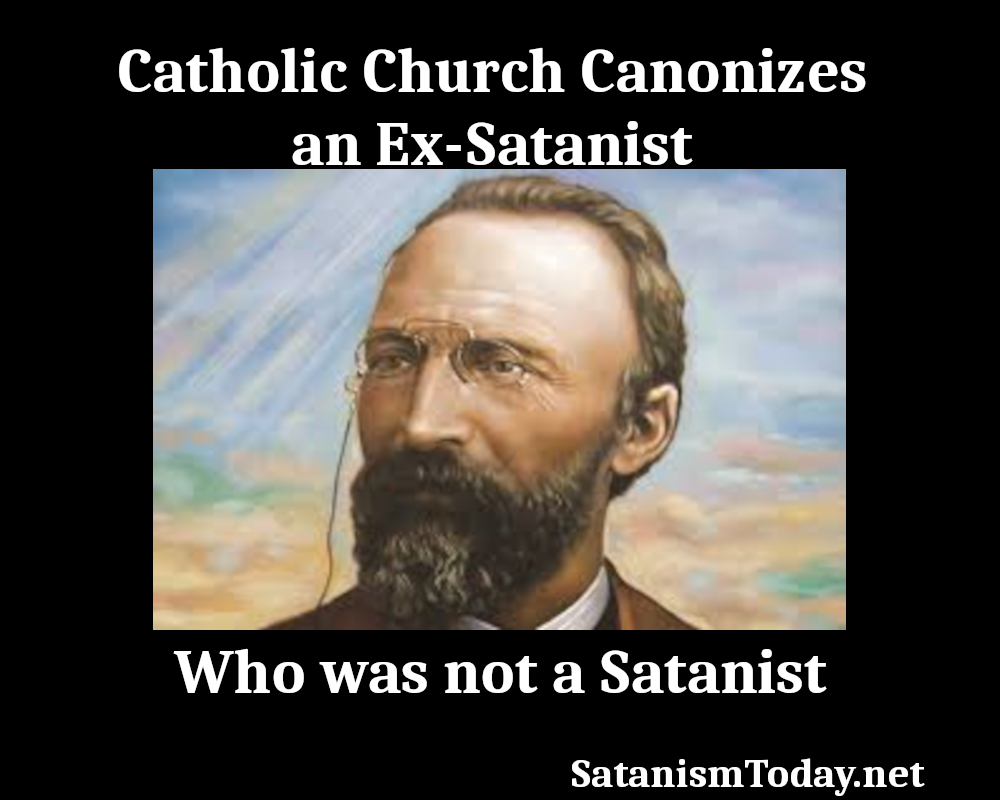
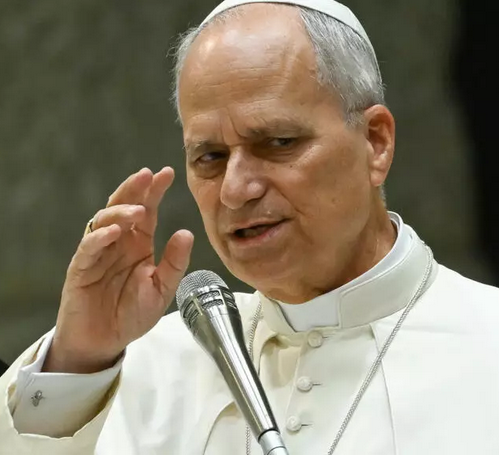
This week, Pope Leo XIV canonized seven new saints, among them an individual controversially described by the Vatican as a “former Satanic priest”, a man named Bartolo Longo. This declaration, while celebrated within Catholic circles, presents a significant mischaracterization of Longo’s past and highlights the Catholic Church’s long-standing tradition of mislabeling and demonizing belief systems that fall outside their doctrines and beliefs.
Here at Satanism Today, it is important to clarify who Bartolo Longo truly was, distinguish his practices from genuine Satanism, and expose the historical inaccuracies perpetuated by the Catholic Church.
Who Was Bartolo Longo?
Bartolo Longo was an Italian lawyer, born in 1841, who lived until 1926. His early life involved a period of intense engagement with a belief system known as Spiritism. After his return to Catholicism, he dedicated his life to the Church, eventually founding the Pontifical Shrine of the Blessed Virgin of the Rosary of Pompeii. It is this period of his life, prior to his Catholic conversion, that the Vatican has chosen to sensationalize by labeling him a “Satanic priest.”
What is Spiritism?
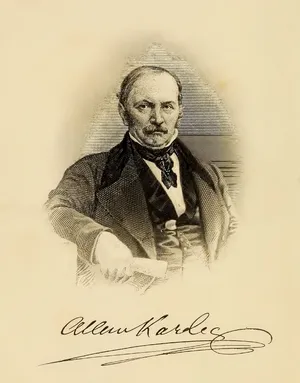
Spiritism, founded by the French educator Allan Kardec in the mid-19th century, is a belief system centered on the idea that a spirit world exists alongside physical reality, accessible through mediums. Some of thier beliefs included reincarnation, where the soul underwent repeated reincarnations to achieve intellectual and moral perfection. Also, they believed that they could communicate with the dead through rituals such as table-tipping.
Funny enough, that Spiritism adheres to many foundational Christian beliefs, including the existence of an omnipotent, benevolent God and the teachings of Jesus. It views humans as spirits temporarily inhabiting bodies, but who also had free will.
Upon research, it appears that the newly canonized saint, Bartolo Longo, never belonged to any Satanic sects, nor was he ever a priest of one. Satanism as a social movement wouldn’t appear for another 40 years, long after his death. He did however, practice Spiritism, which the Catholic church fought against, in order to maintain their status quo. Spiritsm during that era became so popular that it attracted not only the wealthy elite, but the common folk, who turned to it for entertainment during that era. It became a craze, threatening the social standing of the Catholic Church.
The Catholic Church has historically condemned Spiritism, classifying it as superstition and even attributing its manifestations to “Satanic intervention”. This condemnation, dating back to decrees from the Congregation of the Inquisition in the mid-19th century, reflects a clear theological opposition rather than an accurate understanding of Spiritism’s doctrines. The Church had no interest in accurately portraying Spiritism, and instead, condemned it as ‘Satanic’.
The Catholic Church's Mischaracterization and the Actual History of Satanism
The Catholic Church’s branding of Bartolo Longo as a “Satanic priest” is not only inaccurate but also serves to sensationalize his past in a way that reinforces its own narrative of conversion and redemption. Because of the popularity of Satanism today, they are essentially grifting the term to bring their sheep back to the fold.
The term “Satanism” as used by the Church in this context is a theological construct, a catch-all for practices deemed heretical or demonic, rather than a reflection of any organized belief system centered on the worship of Satan.
Satanism, as a recognized and organized religion, did not exist during Bartolo Longo’s lifetime. The first real instances of Satanism appeared in the United States in the 1960’s and 70s, through groups like the Brotherood of the Ram, and Anton LaVey’s Church of Satan.
The Church of Satan was founded in 1966 by Anton LaVey, who also authored The Satanic Bible in 1969. LaVeyan Satanism is an atheistic philosophy that views Satan not as a literal deity to be worshipped, but as a symbol of individualism, self-indulgence, and rebellion against traditional religious authority. It is fundamentally distinct from any form of occultism or spirit communication that Longo might have practiced.
Throughout history, the Catholic Church has frequently invoked the specter of “Satanism” or “devil worship” to demonize and suppress diverse beliefs and practices that challenged its authority or deviated from its dogma. This tactic has been used against various groups, from early pagan religions and Gnostic sects to medieval heresies and, in more recent times, practices like Spiritism. All the while, taking from the traditions and beliefs of those that they conquered, and making it their own, while providing their believers an alternative history.
By labeling Longo’s involvement with Spiritism as “Satanic,” the Church perpetuates a narrative that conflates any non-Christian spiritual exploration with evil, thereby justifying its own historical persecutions and maintaining their social monopoly on spiritual truth.
Another False Narrative, Presented in Real Time
People should be reminded that the Catholic Church, throughout their history, are hardly an authoritative voice on historical events. Bartolo Longo’s journey was one from Spiritism to Catholicism, not from Satanism to sainthood. The Catholic Church’s decision to canonize him while simultaneously misrepresenting his past as “Satanic” is a disingenuous attempt to craft a more dramatic narrative of conversion. It is a stark reminder that the Church is not, and has never been, an authority on what Satanism truly is.
Satanism, as defined by its practitioners, emerged in the latter half of the 20th century and bears no resemblance to the Spiritist practices of late 19th-century Italy. This episode serves as a clear example of historical revisionism, where the Church redefines the past to suit its contemporary agenda, at the expense of accuracy and understanding.
References:
Barron’s. (2025, October 19). Pope Leo to proclaim seven new saints including three nuns. https://www.barrons.com/news/pope-leo-to-proclaim-seven-new-saints-including-three-nuns
Britannica. (n.d.). Spiritism | Beliefs, Practices, & History. Retrieved October 19, 2025, from https://www.britannica.com/topic/Spiritism
Pace, E. (1912). Spiritism. In The Catholic Encyclopedia. New York: Robert Appleton Company. http://www.newadvent.org/cathen/14221a.htm