


A recent satirical article from the Babylon Bee proclaimed, “Satan Blowin’ Up As Top Influencer On Bluesky” [1]. While the piece was intended as humor, it inadvertently highlights a deeper cultural shift occurring within the digital landscape. The satirical premise—that the ultimate rebel figure would find a welcome home on a new, burgeoning social media platform—is more revealing than its authors likely intended.
It serves as a potent allegory for the ongoing migration of users away from established, chaotic platforms toward spaces that prioritize user autonomy and control. This exodus, driven by a rejection of authority and a search for more rational discourse, somehow aligns deeply with the core tenets of modern Satanism.
The Crumbling of a Social Media Empire
The social media landscape is in the midst of a significant upheaval for the past few years. X (formerly Twitter), once the digital town square, has seen a notable exodus of popular users since its acquisition by Elon Musk. A November 2024 article in Forbes detailed this migration, citing a series of unpopular changes that have alienated a large segment of its user base [2]. These changes include the dismantling of the original verification system, a significant reduction in content moderation, and alterations to core functionalities like the block feature. The result has been a platform increasingly perceived as hostile, chaotic, and overrun with low-quality engagement, driving users to seek alternatives. The addition of the AI assistant, who is programmed by Musk to promote certain political beliefs, Grok, has added to the problems that the users on Twitter still deal with today.
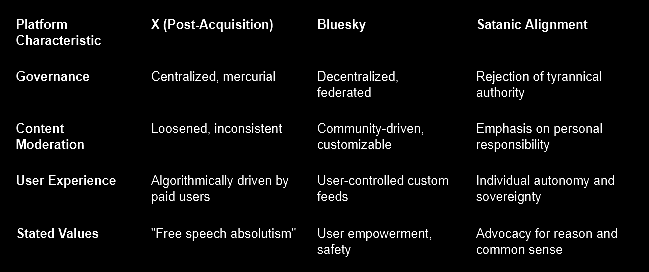
One of the primary beneficiaries of this digital migration has been Bluesky, a decentralized social media platform. As of early 2025, Bluesky has attracted millions of users, many of whom are refugees from X’s increasingly turbulent environment. The platform’s appeal lies in its foundational differences: a federated architecture that gives users more control, customizable content feeds, and a stated commitment to a more community-driven approach to moderation. Data indicates that Bluesky’s user base skews younger and more progressive, with a significant portion of users under the age of 34 [3]. These are demographics that are often more critical of centralized power and more receptive to counter-cultural ideas. This table below illustrates some of these differences:
Satanism in the Era of Digital Rebellion
To understand why a platform like Bluesky would be fertile ground for Satanic ideals, one must first understand modern Satanism itself. Far from the cartoonish depictions of devil worship, contemporary Satanism, particularly as articulated by organizations like The Church of Satan, and later on, The Satanic Temple, is a non-theistic religion that regards Satan as a literary symbol of rebellion against tyranny, not a literal deity. For instance, the mission of The Satanic Temple according to their guidelines is to “encourage benevolence and empathy among all people, reject tyrannical authority, advocate practical common sense, oppose injustice, and undertake noble pursuits” [4].
And, these principles resonate powerfully with the motivations of those leaving platforms like X. The migration to Bluesky is, in essence, a collective act of rejecting a digital environment that has become arbitrary and oppressive. Users are seeking a space where they have greater autonomy, where their feeds are not dictated by the whims of a single owner, and where they can build communities based on shared values rather than algorithmic amplification. This desire for self-determination and a rational, ordered environment over a chaotic, top-down power structure is fundamentally Satanic in principle.
The Devil Is In the Demographics
The Babylon Bee’s satire imagines a literal Satan gleefully gathering followers. The reality is more nuanced and far more interesting. The “popularity” of Satan on a platform like Bluesky is not about a surge in supernatural belief, but about the convergence of a specific demographic, a particular technology, and a shared set of values. The platform’s architecture, which prioritizes user control, naturally attracts individuals who are skeptical of centralized authority—a group that overlaps significantly with those who find Satanic symbolism appealing.
The migration of academics, artists, and politically progressive users to Bluesky creates a cultural environment where the Satanic ideals of free inquiry, rebellion against unjust authority, and the championing of science and reason are more likely to be understood and embraced. In this context,
the symbolic figure of Satan finds a natural home—not as an object of worship, but as a mascot for a digital revolution.
As the old digital empires, built on centralized control and opaque algorithms, begin to show their cracks, new territories are being settled. These new spaces are being built on principles of decentralization, user control, and rational discourse. In this emerging landscape, it is no surprise that the ultimate symbol of rebellion against divine tyranny would be, as the satirists joked, “blowin’ up.” The devil, as they say, is in the details—and in the architecture of a more free and open internet.
You can find Satanism Today at Bluesky, and while you are there visit Satan too!
References:
[1] Babylon Bee. (2025, September 16). Satan Blowin’ Up As Top Influencer On Bluesky. https://babylonbee.com/news/satan-blowin-up-as-top-influencer-on-bluesky
[2] Di Placido, D. (2024, November 19). The X (Twitter) Exodus To Bluesky, Explained. Forbes. https://www.forbes.com/sites/danidiplacido/2024/11/19/the-x-twitter-exodus-to-bluesky-explained/
[3] Duarte, F. (2025, April 25). Bluesky User Age, Gender, & Demographics (2025). Exploding Topics. https://explodingtopics.com/blog/bluesky-users
[4] The Satanic Temple. (n.d.). The Satanic Temple Mission. Retrieved October 5, 2025, from https://thesatanictemple.com